Chapter4 角动量与自旋

Chapter 4

4-1 轨道角动量算符

定义

{L^x=ypz^zpy^L^y=zpx^xpz^L^z=xpy^ypx^\begin{cases} \hat{L}_x = y\hat{p_z} - z \hat{p_y} \\ \hat{L}_y = z\hat{p_x} - x \hat{p_z} \\ \hat{L}_z = x\hat{p_y} - y \hat{p_x} \end{cases}

或者写成

Lj^=ϵjklxk^pl^\hat{L_j} = \epsilon_{jkl}\hat{x_k}\hat{p_l}

角动量算符是厄米算符,因为

  1. 如果两个厄米算符对易,则两个厄米算符之积是厄米算符.
  2. 厄米算符的和差依然为厄米算符。

对易关系

  1. 角动量的各个分量之间是不对易的

[Lx^,Ly^]=Lx^Ly^Ly^Lx^=i(xpy^ypz^)=iLz^[\hat{L_x},\hat{L_y}] = \hat{L_x}\hat{L_y}- \hat{L_y}\hat{L_x} \\ = i\hbar (x\hat{p_y} - y\hat{p_z}) = i\hbar \hat{L_z}

同理,

[Ly^,Lz^]=iLx^[Lz^,Lx^]=iLy^[\hat{L_y},\hat{L_z}] = i\hbar \hat{L_x} \\ [\hat{L_z},\hat{L_x}] = i\hbar \hat{L_y}

    L^×L^=iL^\implies \hat{L} \times \hat{L} = i\hbar\hat{L}

  1. 角动量平方算符与其各分量之间是对易的

    [L^2,Lx^]=[Lx^2+Ly^2+Lz^2,Lx^]=[Ly^2,Lx^]+[Lz^2,Lx^]=Ly^[Ly^,Lx^]+[Ly^,Lx^]Ly^+Lz^[Lz^,Lx^]+[Lz^,Lx^]Lz^=i(Ly^Lz^Lz^Ly^+Lz^Ly^+Ly^Lz^)=0[\hat{L}^2,\hat{L_x}] = [\hat{L_x}^2+\hat{L_y}^2+\hat{L_z}^2,\hat{L_x}] = [\hat{L_y}^2,\hat{L_x}] + [\hat{L_z}^2,\hat{L_x}] \\ =\hat{L_y}[\hat{L_y},\hat{L_x}] + [\hat{L_y},\hat{L_x}]\hat{L_y} + \hat{L_z}[\hat{L_z},\hat{L_x}] + [\hat{L_z},\hat{L_x}]\hat{L_z} \\ = i\hbar(-\hat{L_y}\hat{L_z}-\hat{L_z}\hat{L_y}+\hat{L_z}\hat{L_y}+\hat{L_y}\hat{L_z}) = 0

    [L^2,Ly^]=0[L^2,Lz^]=0[\hat{L}^2,\hat{L_y}] = 0 \\ [\hat{L}^2,\hat{L_z}] = 0

    合并后可以得到

    [L^2,L^]=0[\hat{L}^2,\hat{\vec{L}}] = 0

  2. 角动量与坐标算符对易关系

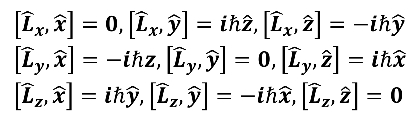
    image-20240610102106205 $$ [\hat{L_i},\hat{x_i}] = 0 \quad [\hat{L_i},\hat{x_j}] = i\hbar \epsilon_{ijk} \hat{x_k} $$
  3. 角动量与动量算符对易关系

    [Li^,pi^]=0[Li^,pj^]=iϵijkpk^[\hat{L_i},\hat{p_i}] = 0 \quad [\hat{L_i},\hat{p_j}] = i\hbar \epsilon_{ijk} \hat{p_k}

  4. 其他关系

    [Li^,p^2]=0[\hat{L_i},\hat{p}^2] = 0

球坐标表示

L^z=iφL^2=Lx^2+Ly^2+Lz^2=2[1sinθθ(sinθθ)+1sin2θ2φ2]\hat{L}_z = -i\hbar \dfrac{\partial}{\partial \varphi} \\ \hat{L}^2 = \hat{L_x}^2 + \hat{L_y}^2 + \hat{L_z}^2 = -\hbar^2[\dfrac{1}{\sin\theta}\dfrac{\partial}{\partial \theta}(\sin \theta \dfrac{\partial}{\partial \theta}) + \dfrac{1}{\sin^2 \theta}\dfrac{\partial^2}{\partial \varphi^2}]

注意:知道L^2\hat{L}^2rr无关即可!

本征值与本征函数

角动量z分量LzL_z​​的本征值与本征函数

需要在球坐标下求解

L^z=iφ\hat{L}_z = -i\hbar \dfrac{\partial}{\partial \varphi}

本征方程

Lz^ψ=λψ    ψ=Aeiλφ\hat{L_z} \psi = \lambda \psi \implies \psi = A e^{\frac{i}{\hbar} \lambda \varphi}

连续性条件

ψ(0)=ψ(2π)\psi(0) = \psi(2\pi)

本征值

λ=m,m=0,±1,±2,\lambda = m \hbar, m = 0,\pm 1,\pm 2,\cdots

m称为磁量子数

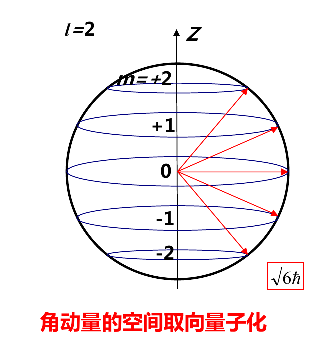
Lz^\hat{L_z}的本征值确定了角动量和z方向的夹角θ\theta的方向

可见,微观系统的角动量在z方向的分量只能取分离值(零或\hbar​的整数倍)。所以角动量在空间任意方向的投影是量子化的。

本征函数

ψm(φ)=Aeimφ\psi_m(\varphi) = A e^{im\varphi}

归一化条件

02πψm(φ)2dφ=A202πdφ=2πA2=1    A=12π\int_0^{2\pi}\lvert \psi_m(\varphi) \rvert^2 d\varphi = A^2 \int_{0}^{2\pi} d\varphi = 2\pi A^2 = 1 \\ \implies A=\dfrac{1}{\sqrt{2\pi}}

可得归一化本征函数

ψm(φ)=12πeimφ,m=0,±1,±2,\psi_m(\varphi) = \dfrac{1}{\sqrt{2\pi}} e^{im\varphi}, m = 0,\pm 1,\pm 2,\cdots

角动量的平方L^2\hat{L}^2​的本征值与本征函数

本征方程

L2^Y(θ,φ)=L2Y(θ,φ)=λ2Y(θ,φ)\hat{L^2}Y(\theta,\varphi) = L^2Y(\theta,\varphi) = \lambda \hbar^2Y(\theta,\varphi)

代入角动量平方算符,可以得到一个球谐函数方程,其中Y(θ,φ)Y(\theta,\varphi)就是L2^\hat{L^2}属于本征值λ2\lambda \hbar^2的本征函数

[1sinθθ(sinθθ)+1sin2θ2φ2]Y(θ,φ)+λY(θ,φ)=0[\dfrac{1}{\sin\theta}\dfrac{\partial}{\partial \theta}(\sin \theta \dfrac{\partial}{\partial \theta}) + \dfrac{1}{\sin^2 \theta}\dfrac{\partial^2}{\partial \varphi^2}] Y(\theta,\varphi) + \lambda Y(\theta,\varphi) = 0

该方程可以分离变量法求解(过程略),最终得到本征函数

Ylm(θ,φ)=Θ(θ)ψm(φ)Y_{lm}(\theta,\varphi) = \Theta(\theta)\psi_m(\varphi)

其中

Θ(θ)=(1)m2l+12(lm)!(l+m)!Plm(cosθ)ψm(φ)=12πeimφ,m=0,±1,,±l\Theta(\theta) = (-1)^m\sqrt{\dfrac{2l+1}{2}\dfrac{(l-m)!}{(l+m)!}}P_l^m(cos \theta) \\ \psi_m(\varphi) = \dfrac{1}{\sqrt{2\pi}} e^{im\varphi}, m = 0,\pm 1,\cdots,\pm l

注:

Plm(cosθ)mlP_l^m(cos \theta) \quad \lvert m \rvert \leq l

为m阶l次连带勒让德函数

本征函数全部写开如下:

Ylm(θ,φ)=(1)m2l+14π(lm)!(l+m)!Plm(cosθ)eimφY_{lm}(\theta,\varphi) = (-1)^m\sqrt{\dfrac{2l+1}{4\pi}\dfrac{(l-m)!}{(l+m)!}}P_l^m(cos \theta) e^{im\varphi}

本征值

λ2=l(l+1)2l=0,1,2,\lambda \hbar^2 = l(l+1) \hbar^2 \quad l=0,1,2,\cdots

其中ll称为角量子数

L2^\hat{L^2}的本征值确定了角动量的大小

总结

image-20240610111851149 $$ \hat{L_z} Y_{lm} = m\hbar Y_{lm} \\ \hat{L^2} Y_{lm} = l(l+1)\hbar^2 Y_{lm} \\ l = 0,1,2\cdots \quad m = 0,\pm 1,\pm 2\cdots, \pm l $$
  1. 球谐函数系YlmY_{lm}LzL_zL2L^2共同的本征函数

  2. LzL_zL2L^2的本征值是有关联的:llmm需满足一定关系

    L2=l(l+1)2Lz=ml=0,1,2m=0,±1,±2,±l(ml)L^2 = l(l+1)\hbar^2 \\ L_z = m \hbar \\ l = 0,1,2\cdots \quad m = 0,\pm 1,\pm 2\cdots, \pm l \quad(\lvert m \rvert \leq l)

  3. 角动量的本征值为

    L=l(l+1)L = \sqrt{l(l+1)}\hbar

  4. 角动量L2^\hat{L^2}的本征值是2l+12l+1度简并的:属于本征值l(l+1)2l(l+1)\hbar^2的线性独立本征函数Ylm(θ,φ)Y_{lm}(\theta,\varphi)共有2l+12l+1个,因为对于同一个ll,m可以取0,±1,,±l0,\pm1,\cdots,\pm l2l+12l+1个值

4-2 自旋

电子自旋假设

  • 每个电子都具有自旋角动量,它在空间任何方向上的投影只能取两个数值

  • 每个电子都具有自旋磁矩,它与自旋角动量有如下关系

    Ms=emeS\vec{M_s} = \dfrac{-e}{m_e}\vec{S}

自旋算符

自旋角动量也由一个算符描写,记为S^\hat{\vec{S}}

自旋角动量是一个假设,满足如下结论:

S^×S^=iS^[Sx^,Sy^]=iSz^[Sy^,Sz^]=iSx^[Sz^,Sx^]=iSy^\hat{S} \times \hat{S} = i \hbar \hat{S} \\ [\hat{S_x},\hat{S_y}] = i\hbar \hat{S_z} \\ [\hat{S_y},\hat{S_z}] = i\hbar \hat{S_x} \\ [\hat{S_z},\hat{S_x}] = i\hbar \hat{S_y}

由于自旋角动量在空间任意方向上的投影只能取±2\pm \dfrac{\hbar}{2}两个值,所以Sx^Sy^Sz^\hat{S_x} \hat{S_y} \hat{S_z}本征值都是±2\pm \dfrac{\hbar}{2},其平方为(2)2(\dfrac{\hbar}{2})^2

从而可以推出自旋角动量平方本征值

S2=s(s+1)2=342Sz=ms=±12S^2 = s(s+1) \hbar^2 = \dfrac{3}{4} \hbar^2 \\ S_z = m_s \hbar = \pm \dfrac{1}{2}\hbar

s为自旋量子数只有一个数值s=12s = \dfrac{1}{2}

msm_s为自旋磁量子数ms=±12m_s = \pm \dfrac{1}{2}

自旋角动量大小

S=32S = \dfrac{\sqrt{3}}{2} \hbar

含自旋状态的波函数

Ψ=Ψ(x,y,z,Sz,t)\Psi = \Psi (x,y,z,S_z,t)

含自旋状态的波函数写成列矩阵

Φ(r,Sz,t)=[1]\Phi(\vec{r},S_z,t) = \begin{bmatrix} 1 \end{bmatrix}

Pauli算符

S^=2σ^\hat{\vec{S}} = \dfrac{\hbar}{2} \hat{\vec{\sigma}}

{Sx=2σxSy=2σySz=2σz\begin{cases} S_x = \dfrac{\hbar}{2} \sigma_x \\ S_y = \dfrac{\hbar}{2} \sigma_y \\ S_z = \dfrac{\hbar}{2} \sigma_z \end{cases}

对易关系

S^×S^=iS^    σ^×σ^=2iσ^\hat{S} \times \hat{S} = i \hbar \hat{S} \implies \hat{\vec{\sigma}} \times \hat{\vec{\sigma}} = 2i \hat{\vec{\sigma}}

分量形式

[σx^,σy^]=2iσz^[σy^,σz^]=2iσx^[σz^,σx^]=2iσy^[\hat{\sigma_x},\hat{\sigma_y}] = 2i \hat{\sigma_z} \\ [\hat{\sigma_y},\hat{\sigma_z}] = 2i \hat{\sigma_x} \\ [\hat{\sigma_z},\hat{\sigma_x}] = 2i \hat{\sigma_y}

σx,σy,σz\sigma_x,\sigma_y,\sigma_z的本征值都是±1\pm 1

σx2,σy2,σz2\sigma^2_x,\sigma^2_y,\sigma^2_z的本征值都是1,即σx2=σy2=σz2=1\sigma_x^2 = \sigma_y^2 = \sigma_z^2 = 1

反对易关系

σx^σy^+σy^σx^=0orσx^σy^=σy^σx^\hat{\sigma_x}\hat{\sigma_y} + \hat{\sigma_y} \hat{\sigma_x} = 0 \quad or \quad \hat{\sigma_x}\hat{\sigma_y} = -\hat{\sigma_y} \hat{\sigma_x}

由此还可以得出如下的有用性质

σx^σy^=σy^σx^=iσz^\hat{\sigma_x}\hat{\sigma_y} = -\hat{\sigma_y} \hat{\sigma_x} = i \hat{\sigma_z}

pauli算符的矩阵形式

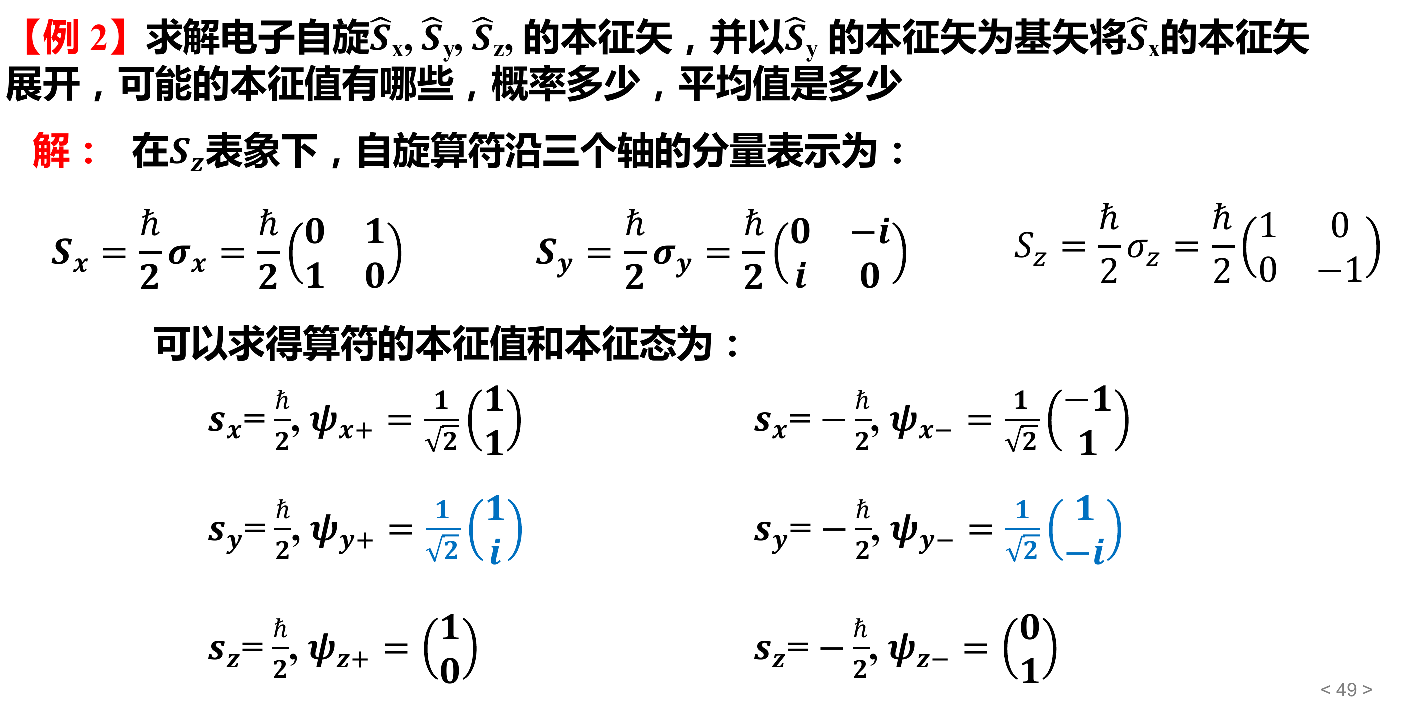
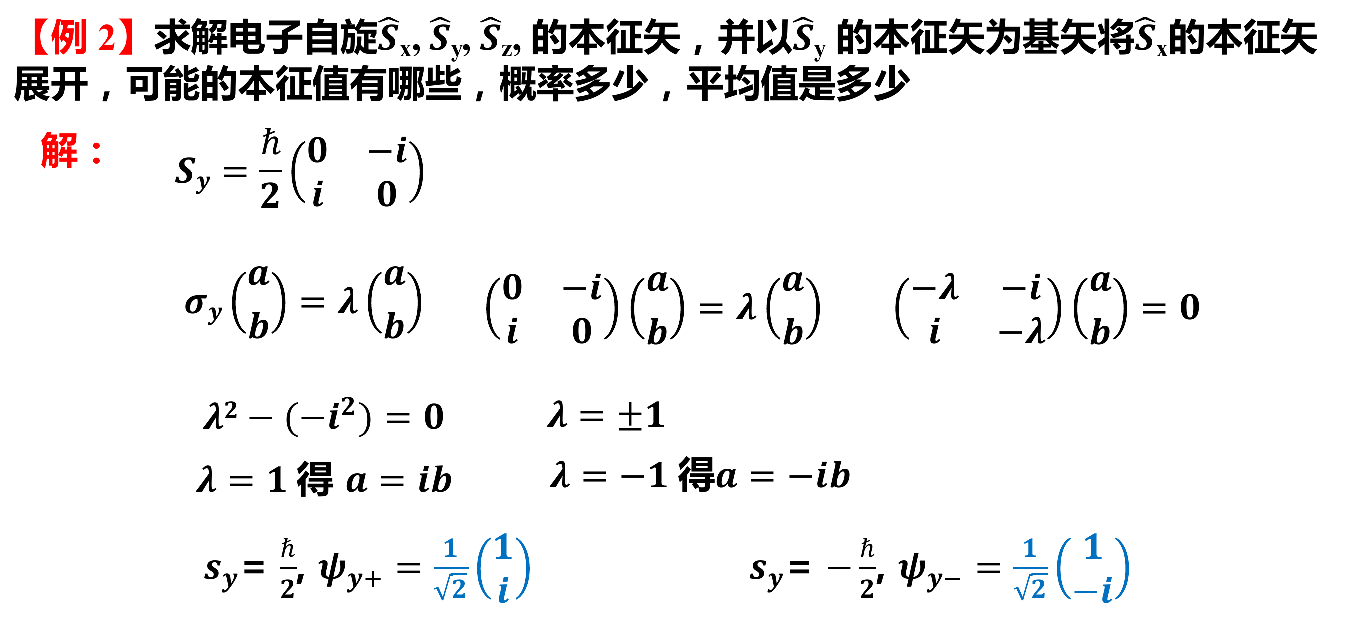
SzS_z表象下,自旋算符可以表示为

σx=[0110]σy=[0ii0]σz=[1001]Sx=2σx=2[0110]Sy=2σy=2[0ii0]Sz=2σz=2[1001]\sigma_x = \begin{bmatrix} 0 & 1 \\ 1 & 0 \end{bmatrix} \quad \sigma_y = \begin{bmatrix} 0 & -i \\ i & 0 \end{bmatrix} \quad \sigma_z = \begin{bmatrix} 1 & 0 \\ 0 & -1 \end{bmatrix} \\ S_x = \dfrac{\hbar}{2}\sigma_x = \dfrac{\hbar}{2}\begin{bmatrix} 0 & 1 \\ 1 & 0 \end{bmatrix} \\ S_y = \dfrac{\hbar}{2}\sigma_y = \dfrac{\hbar}{2}\begin{bmatrix} 0 & -i \\ i & 0 \end{bmatrix} \\ S_z = \dfrac{\hbar}{2}\sigma_z = \dfrac{\hbar}{2}\begin{bmatrix} 1 & 0 \\ 0 & -1 \end{bmatrix}

自旋波函数

通常自旋和轨道运动之间是有相互作用的,所以电子的自旋状态对轨道运动有影响。但是,当这种相互作用很小时,可以将其忽略,也就是可以对波函数进行分离变量

ϕ(r,Sz,t)=ψ(r,t)χ(Sz)\phi(\vec{r},S_z,t) = \psi(\vec{r},t) \chi(S_z)

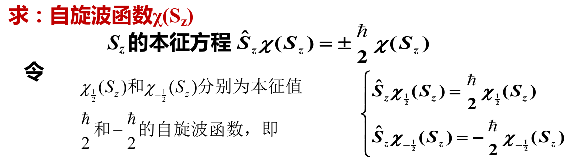
其中χ(Sz)\chi(S_z)Sz^\hat{S_z}本征函数,称为自旋波函数

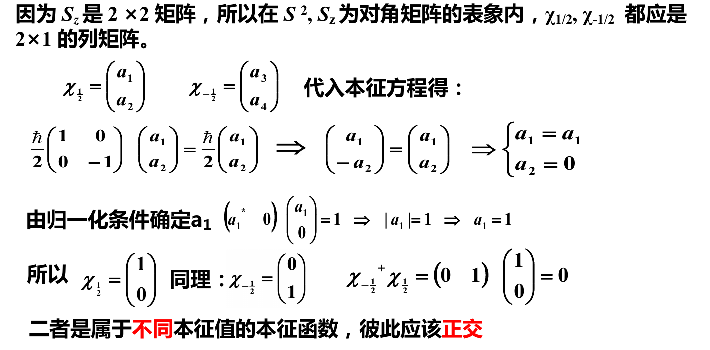
image-20240610113741259

image-20240610113801732

总结

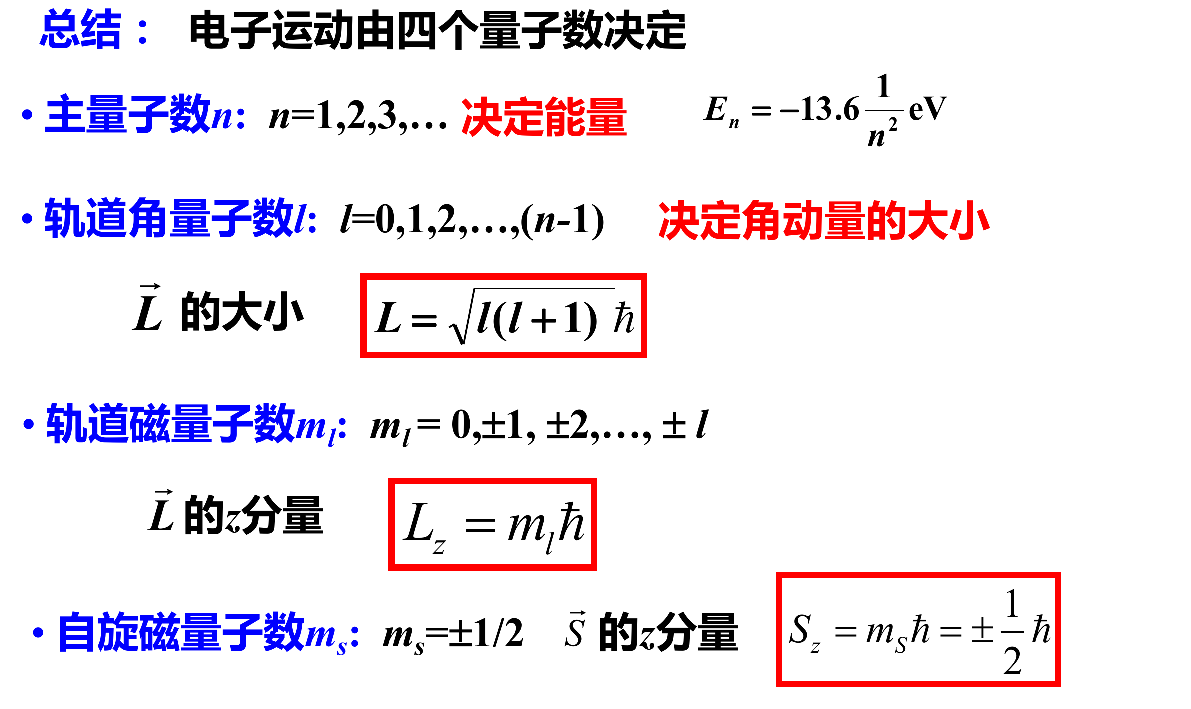
image-20240610114954490

例题

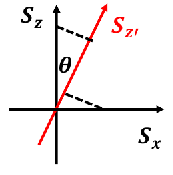
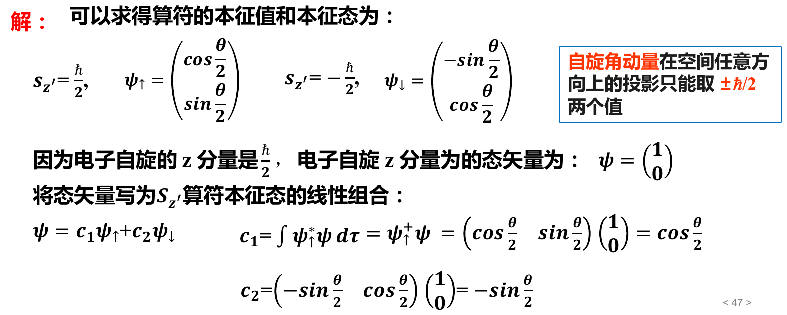
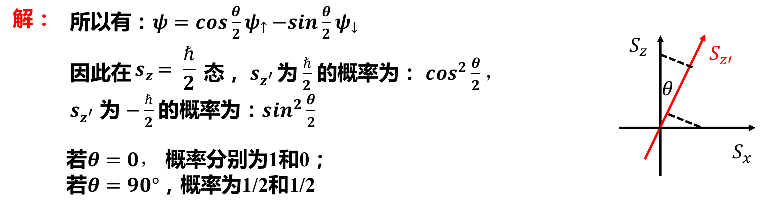
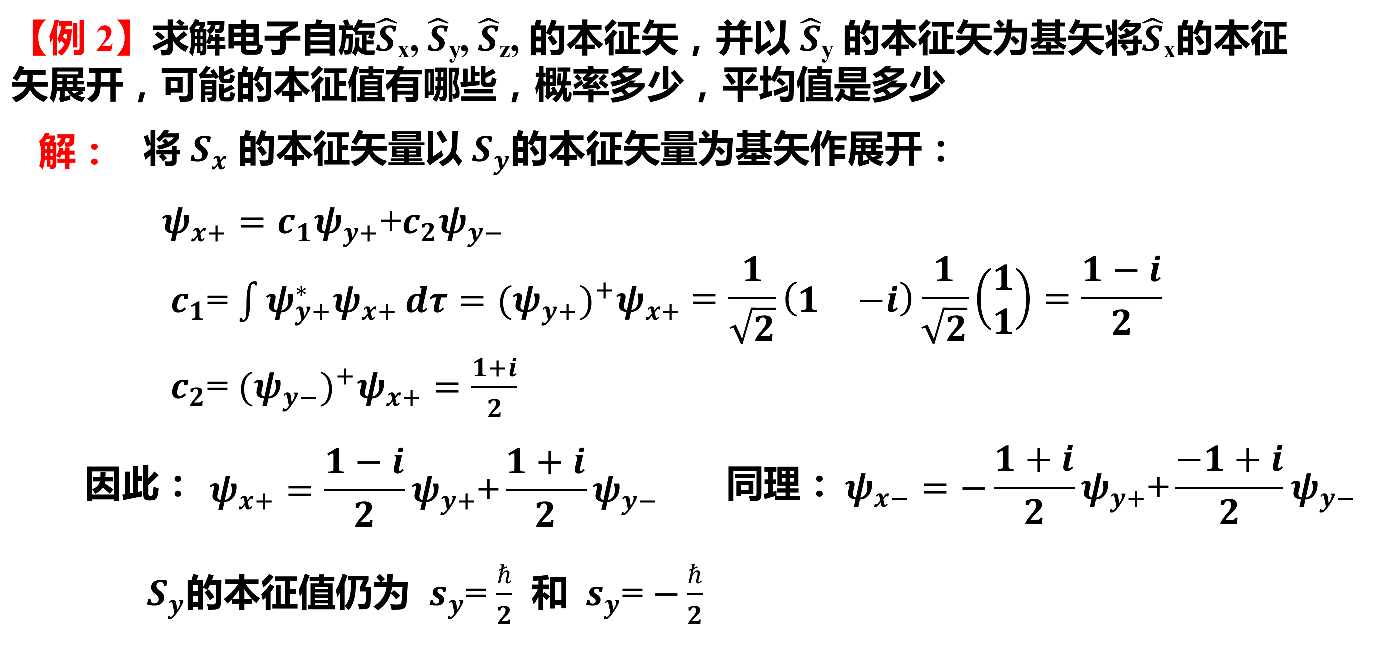
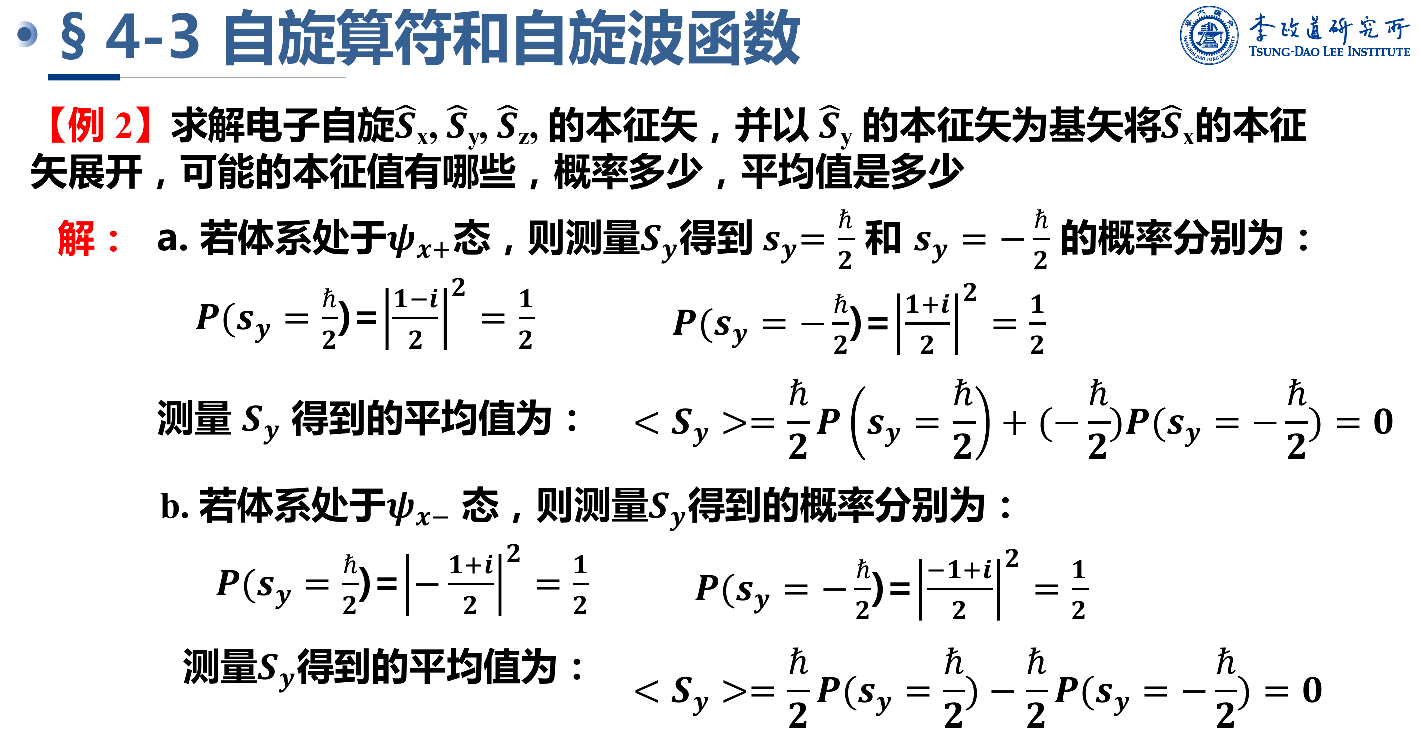
  1. 电子自旋z分量是1\dfrac{\hbar}{1},求沿着与z轴成θ\theta角的zz'方向,自旋分量为2\dfrac{\hbar}{2}2-\dfrac{\hbar}{2}的概率?

image-20240428151549274

SzS_z表象下,自旋算符沿三个轴的分量表示为

设转轴沿y轴正向,则自旋算符沿z’轴的分量为

Sz=Szcosθ+Sxsinθ=2[cosθsinθsinθcosθ]S_{z'} = S_z cos \theta + S_x sin \theta = \dfrac{\hbar}{2}\begin{bmatrix} cos \theta & sin \theta \\ sin \theta & -cos \theta \end{bmatrix}

image-20240610114107120

image-20240610115637120

image-20240610120236636

image-20240610120308621

image-20240610120434800

0%